Football coaches, one of the hardest problems in the game is breaking down a side that sits deep and refuses to come out. You dominate possession, you move the ball side to side, and you still end up crossing from a poor angle or shooting from thirty yards.
The third man run is the most reliable answer. It is the pattern behind a huge share of well worked goals at elite level, and it is completely teachable at grassroots level once players understand the roles involved.
In this post we break down the six principles you need to cover so your players stop passing around a defence and start passing through it.
1. Know the Three Roles: Passer, Bounce, Runner
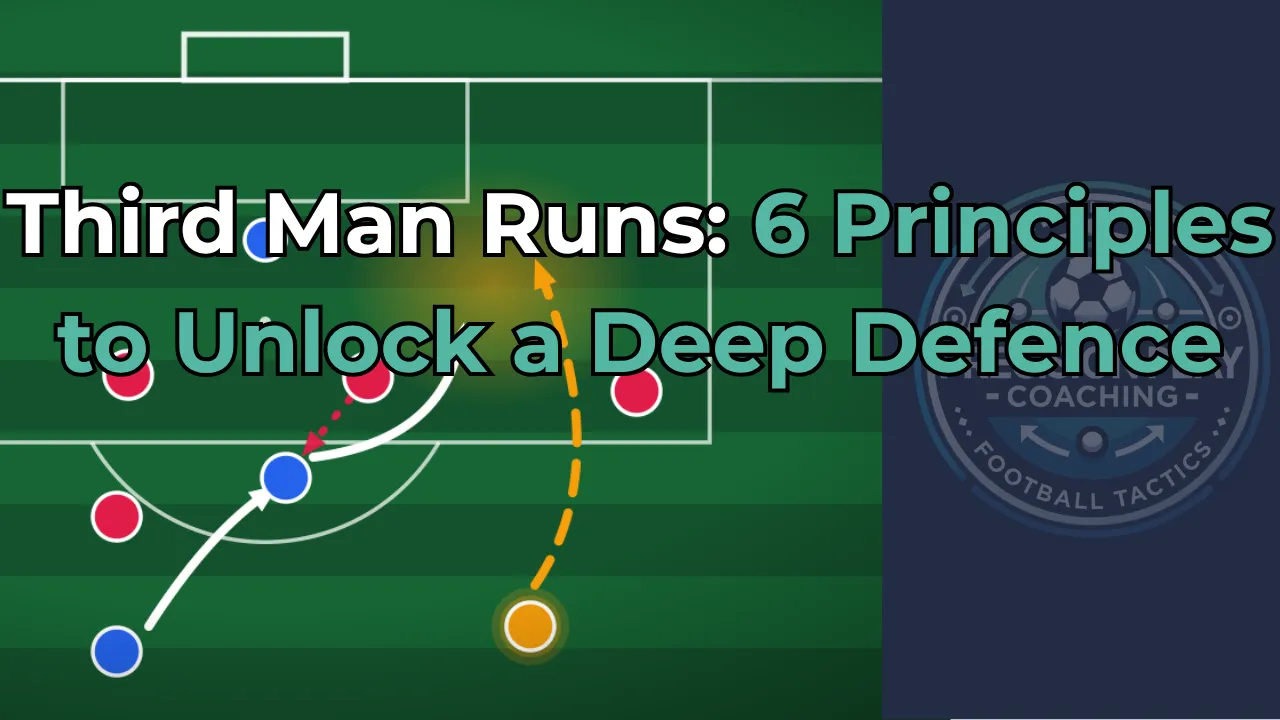
A third man run involves three players and two passes. Player A passes to Player B. Player C, the third man, arrives into space and receives from Player B. Player C never touched the first pass, which is exactly why the defence struggles to track them.
The key coaching point is that the third man is not the player who starts the move. Defenders naturally follow the ball and the two players directly involved in it. The runner arrives from outside that picture, which is what creates the separation.
Give players the language early. "Who is the third man here?" is a question you can ask at any stoppage in any session.
2. The First Pass Is Bait, Not Progress
Young players often judge a pass by whether it went forward. The first pass in a third man sequence usually goes sideways or backwards, and that is the point.
Its job is to move a defender. When a centre-back steps out to press the bounce player, or a midfielder shuffles across to cover, the gap behind them opens for a fraction of a second. That gap is the target.
Teach players to look at what the first pass drags, not where it travels. A pass that pulls a defender two yards out of position has done more damage than a safe forward pass into a wall of bodies.
3. The Bounce Player Sets the Tempo
The middle man is the most demanding role and the one most often coached badly. Three non-negotiables:
- One or two touches maximum. The gap closes fast. A third touch usually kills the move.
- Open body shape before the ball arrives. Half-turned, back foot open, so they can see the runner and the space behind without needing to turn first.
- Scan early. The decision must be made before the ball is received, not after.
If your bounce players are controlling, looking up, then passing, the pattern will never work in a real game. Constrain them to two touches in practice until it becomes habit.
4. Timing: Late Is Better Than Early
The single most common error is running too soon. An early run gets tracked, gets flagged offside, or simply arrives before the space exists.
The runner should be moving as the second pass is being prepared, not as the first one is played. A short delay, a half step in the wrong direction, or a check away before accelerating all buy the separation you need.
Use this cue with players: "Let the ball travel first, then you travel." The ball is always faster than a defender's head turn.
5. Angle of Run: Behind, Not Beside
A run alongside the bounce player gives the defender an easy decision. A run that curves in behind them forces the defender to choose between the ball and the runner, and they cannot cover both.
- Through the half-spaces between full-back and centre-back, the highest value channel in modern attacking play.
- Across a defender's blind side, arriving behind their shoulder rather than in front of them.
- Into the space the bait pass created, not into a space that looked open ten seconds ago.
Curved runs also keep the runner onside longer and open up the body to receive facing goal.
6. Recognise the Trigger
Patterns only work when players spot them without being told. Train the triggers:
- A defender steps out to press the bounce player.
- A midfielder drops into a pocket between the lines and receives with their back to goal.
- The ball is switched and the far side defence is still shuffling across.
- A player passes wide and the opposition full-back commits forward.
Every one of these moments creates a temporary gap. If your players learn to attack those moments rather than wait for instruction, you have coached decision making, not just a rehearsed move.
"The defence watches the ball and the two players near it. The third man is the one nobody is watching, and that is why they score."
Coaching Third Man Runs in Sessions
Bring these principles to life with:
- Unopposed pattern play in a Y shape or triangle to get the timing and body shape right before adding pressure.
- Rondos with a scoring rule, one point for keeping the ball, three points for a completed third man combination through the middle.
- Positional games such as 6v4 plus two, where progressing to the target zone must involve three different players in the sequence.
- Small sided games with a bonus goal awarded for any goal created by a third man run, which forces players to hunt the pattern under real pressure.
- Video clips of Manchester City, Arsenal, and Spain, freezing the frame the moment the first pass is played and asking players to predict where the third man arrives.
Watch for the three usual faults: the run going too early, the bounce player taking a third touch, and the first pass being played too hard for the receiver to bounce cleanly. Fix those and the rest follows.
Coach these six principles consistently and your team will stop being frustrated by low blocks. They will start pulling them apart.
PrecisionPlayCoaching