Instructions
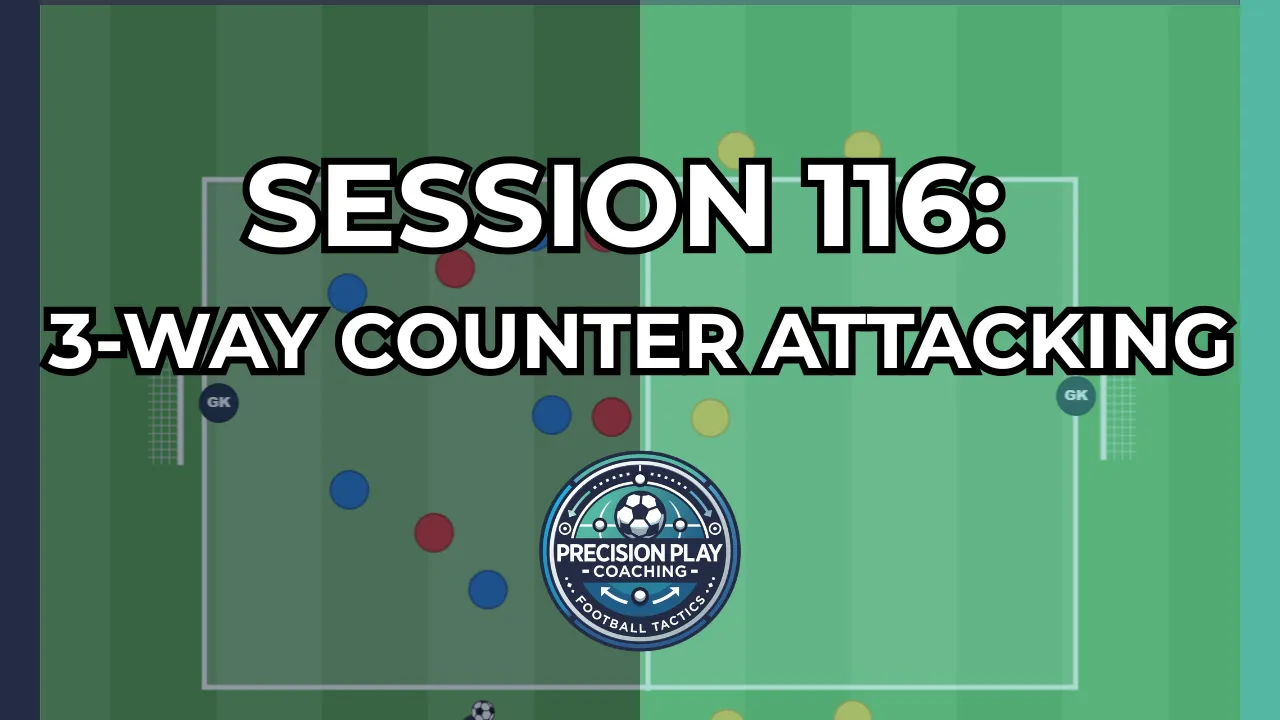
Set up a 30x20 yard area divided into 3 vertical lanes (each approx. 10 yards wide) using cones or lines.
Place small goals or target lines at each end of the area (or use mannequins/flat markers if no goals).
Divide players into two teams, with players starting in corresponding lanes (e.g., one attacker and one defender per lane initially).
Start with 1v1 situations in individual lanes: attackers aim to dribble or pass the ball to the opposite end to score.
Progress by allowing players to combine: introduce support play within structured lanes to encourage 2v2 or 3v3 elements.
Final progression: remove lane restrictions for free 3v3 play across the entire area, creating a realistic small-sided game.
Rotate players after each successful attack or set time intervals to maintain high intensity.
Focus Points
Encourage attackers to be positive in 1v1 situations: attack with speed, use feints and changes of direction to unbalance defenders.
Defenders must maintain a low, side-on stance, delay the attacker, and force play to one side rather than allowing central penetration.
Promote quick decision-making: attackers decide early whether to dribble past or pass to a teammate when support arrives.
Emphasize movement off the ball: players without the ball must offer angles for support, create overloads, and make forward runs.
Highlight defensive responsibility: when possession is lost, immediate counter-press or recovery to delay the counter-attack.
Reinforce transitions: both teams must react instantly – attackers become defenders and vice versa – to build game realism.
Praise high effort, competitiveness, and intensity: reward brave 1v1 actions and strong defensive recoveries.
Coach body position: attackers keep the ball close and head up to scan; defenders stay patient and avoid lunging in recklessly.
Progressions
Start with strict lane restrictions (no crossing lanes) for pure 1v1 isolation.
Introduce limited crossing: allow one player per team to move between lanes for support play (e.g., 2v2 combinations).
Progress to full 3v3 with lane restrictions initially to force structured combination play.
Remove all lane restrictions for free movement, adding realism and decision-making.
Add conditions: e.g., must complete 2 passes before scoring, or limit touches to encourage quick play.
Increase difficulty: add time limits per attack, or make it directional with goals only counting in one direction.
Variation for overload: start as 2v1 or 3v2 progressing to even-sided.
For advanced groups: incorporate recovery runs or resting players who must join after a goal.
Four Corner Model
Technical / Tactical
Defensive stance and jockeying, pressing angles, tackling and intercepting technique, quick decisions on when to dribble or pass, combination play and support angles.
Psychological
Concentration and focus throughout transitions, patience in waiting for the right moment, anticipation of opponent's moves, resilience after losing possession or failed attempts.
Physical
Agility and quick changes of direction, acceleration and speed in 1v1 duels, strength in shielding and physical challenges, endurance to maintain intensity in repeated actions.
Social
Communication to organize and call for support, teamwork in collective defending and attacking, respect for opponents in competitive situations, cooperation during combinations.
Principles of Play
In Possession
Penetration
Create Space
Movement
Support
Creativity
Out of Possession
Press
Delay
Cover & Balance
Compactness