On 19 July 2026, Spain beat Argentina 1-0 after extra time at MetLife Stadium to win the FIFA World Cup, a second title for the nation and their first since 2010. Ferran Torres struck the winner in the 106th minute, Rodri controlled the midfield throughout, and Lionel Messi's Argentina managed just two shots across 120 minutes.
For coaches, the real story isn't the scoreline, it's the system behind it. Luis de la Fuente built a Spain side that didn't need a single tactical shift all tournament, and that consistency is exactly what makes this squad worth studying in detail.
1. The Base Shape: A Modernised 4-3-3
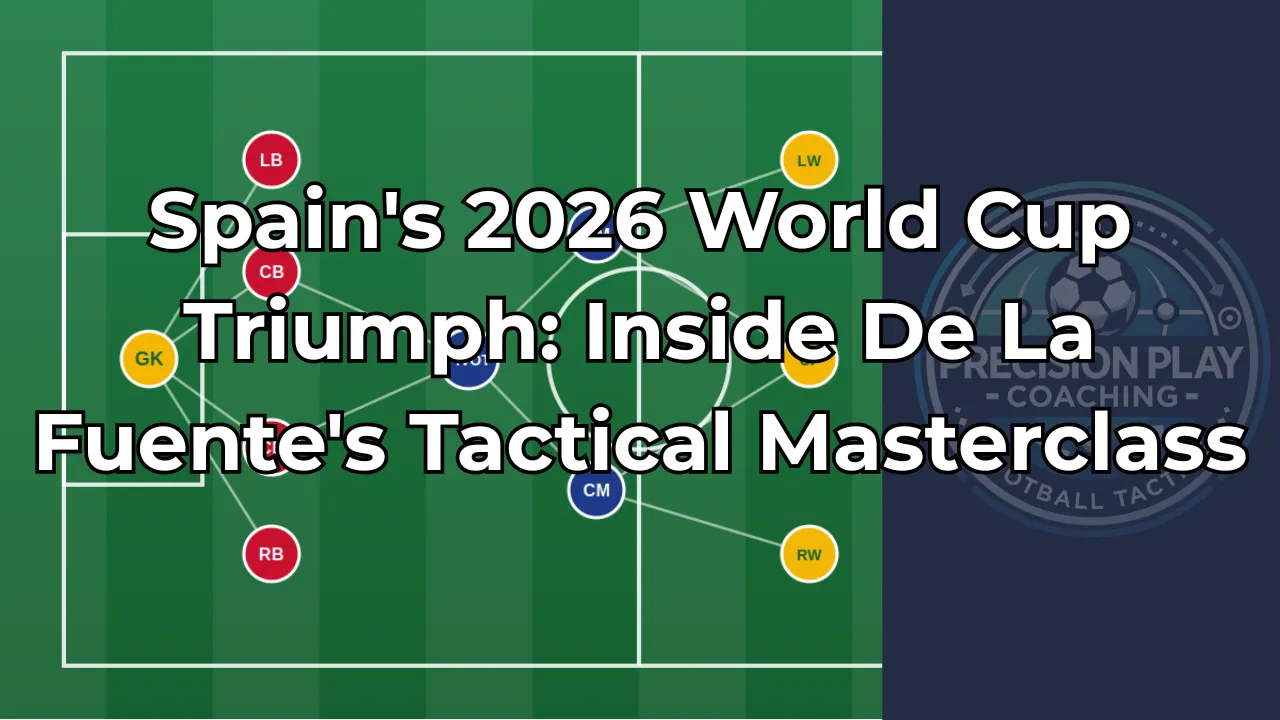
De la Fuente builds from a 4-3-3, but it's not the patient, sideways-passing Spain of the past. Rodri sits as the lone pivot in front of the back four, controlling tempo and screening the defence, while two advanced central midfielders operate in the half-spaces rather than staying flat.
The base structure looks like this:
- Back four: two centre-backs, a left-back and right-back who tuck and overlap depending on the phase
- Midfield three: Rodri as the single pivot, with two box-to-box or half-space midfielders ahead of him
- Front three: two wide forwards who stay high and wide, plus a central forward who often drops deep to link play
2. Positional Play That Morphs Into a 3-2-5
What separates this Spain side from a standard 4-3-3 is what happens when they commit players forward. In sustained possession, the shape restructures into a 3-2-5 or 2-3-5: one full-back tucks in alongside the centre-backs to form a back three, the other pushes on, and five players occupy the last line to stretch the opposition defence horizontally.
This isn't improvised. It's a rehearsed structural shift, and it means Spain almost always have a spare man in build-up and numbers on the last line in attack, without ever leaving themselves exposed in transition.
Coaching cue: teach players that formation numbers aren't fixed positions, they're a starting shape. The real skill is knowing which zone to fill when a teammate moves out of it.
3. Centre-Backs Who "Attract to Isolate"
One of the more advanced principles in Spain's build-up is what analysts call "attract to isolate": centre-backs are actively encouraged to dribble forward into midfield space, drawing an opponent out of position before releasing a pass into the pocket that opponent just vacated.
This demands elite ball-striking and composure under pressure from defenders, not just simple distribution. It's a high-risk, high-reward tool, and it's not one to introduce with beginners, but for advanced youth or adult players, it's a brilliant progression once basic playing-out-from-the-back patterns are solid.
4. Width Comes From 1v1 Threat, Not Just Positioning
Spain's wide forwards aren't there simply to stretch the pitch, they're a direct goal threat. Their ability to beat a full-back one-on-one forces opponents to double up out wide, which in turn opens central space for the midfield three and the underlapping full-back to exploit.
This is a useful lesson for any coach working on width in a session: width isn't valuable just because it's wide, it's valuable because it creates a decision the defender has to get right, every single time.
5. A False Nine Who Drops to Overload Midfield
Spain's central forward regularly drops off the front line into midfield, which temporarily removes a fixed striker from the last line. Because of this, one of the wide forwards or an advancing midfielder must recognise the gap and occupy that space instead, keeping depth in the attack.
It's a rotation that only works with players who read the game well collectively, not just individually, which is why De la Fuente leans on a core of players from Spain's youth pathway who've grown up inside this positional framework together.
6. Compact Out of Possession, Fast to Counter-Press
Defensively, Spain keep tight distances between their lines so that the moment possession is lost, multiple players are already within reach of the ball to counter-press immediately. Rather than dropping into a deep, reactive block, Spain try to win the ball back high and fast, before the opponent can organise.
Against Argentina in the final, this discipline was the difference: Messi was rarely allowed to receive the ball in space, with Rodri and the midfield line shifting as a unit to close central passing lanes all night.
7. Tactical Consistency Under Pressure
Perhaps the most coachable trait of all: Spain didn't abandon their principles regardless of scoreline or match state. Many international sides go direct or defensive when protecting a lead or chasing a game. De la Fuente's Spain stuck to their possession-based identity throughout the tournament, including 90 goalless minutes in the final itself.
Good systems aren't the ones that only work when things are going well. They're the ones a team trusts enough to stick with when they're not.
Taking This Into Your Own Sessions
You don't need international-level players to borrow these principles. Try adapting them at grassroots or academy level with:
- Rondos that reward players for playing forward into space a teammate has just vacated, not just circulating the ball
- Small-sided games where one "pivot" player must always stay in front of the defence, teaching positional discipline
- 1v1 wide overload drills to build the confidence to isolate a full-back and go at them
- Transition games where losing the ball triggers an immediate counter-press rule, for example, win it back within 6 seconds or reset
Spain's 2026 win wasn't built on individual brilliance alone. It was built on a structure every player understood well enough to execute under the biggest pressure in football. That's a principle worth coaching at every level.
PrecisionPlayCoaching