Introduction: The Formation That Never Gets Old
Picture this: a system that can switch from silky possession football to ferocious high pressing in the blink of an eye. That's the beauty of the 4-3-3. It's been the backbone of some of the most exciting teams of the last two decades, Barcelona's tiki-taka dynasty, Liverpool's heavy-metal football, Manchester City's relentless control. But here's the real magic: the same formation looks completely different depending on who's holding the clipboard.
In this tactical deep-dive we'll dissect the 4-3-3's core DNA, celebrate its killer strengths, expose its vulnerabilities, and showcase how the world's best managers twist it to fit their philosophy. Coaches, analysts, and passionate fans, get ready to take notes.
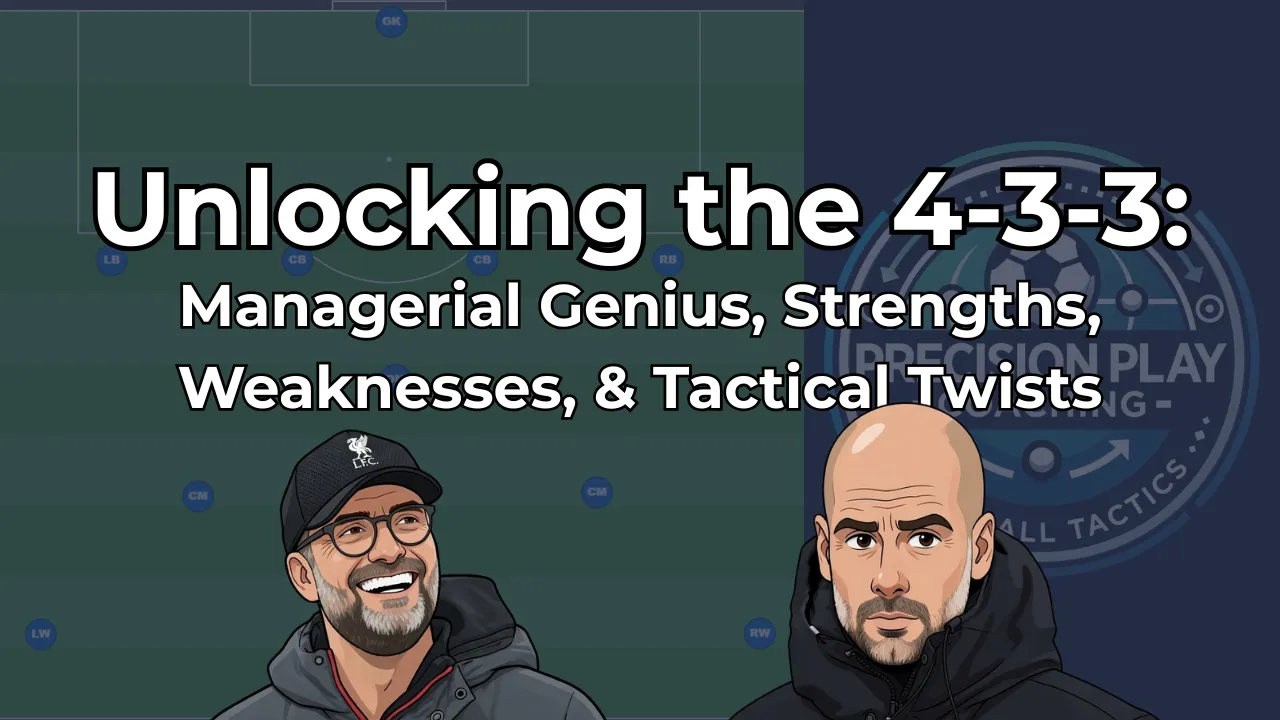
The Classic 4-3-3 Shape
Four defenders. Three midfielders. Three forwards. Simple on paper, explosive in practice.
- Two centre-backs + two full-backs
- One holding midfielder (the pivot) + two more dynamic central midfielders
- One central striker flanked by two wide forwards/wingers
That basic structure creates natural passing triangles everywhere, the foundation of modern attacking play.
Strengths: Why Teams Love the 4-3-3
The 4-3-3 gives you balance, flexibility, and serious teeth going forward. Here's why it remains elite coaches' first choice:
- Midfield superiority — Three central players usually outnumber the opposition's two, allowing you to control tempo and dictate play.
- Natural width & depth — Wingers stretch the pitch horizontally while overlapping full-backs add vertical threat. Suddenly you're attacking with five players.
- High pressing made easy — The front three can trigger aggressive pressing high up the pitch, turning turnovers into instant goal threats (hello, gegenpressing).
- Quick transitions — Recover the ball centrally and you've already got three attackers sprinting forward, lethal on the counter.
- In-game flexibility — Drop into a 4-5-1 defensively, push to a 3-4-3 in attack, or morph into a 4-2-3-1 with one winger tucking in. It's shape-shifting at its finest.
Weaknesses: The Cracks Smart Opponents Exploit
No formation is perfect. Here are the main danger zones coaches must constantly drill:
- Exposed wide areas — When full-backs bomb forward (which they should in this system), counters down the flanks can punish you badly.
- Reliance on the holding midfielder — If your No.6 is overrun, bypassed, or caught out of position, the whole structure collapses.
- Isolated centre-forward — Without intelligent movement from the wide players, the lone striker can become a passenger against compact defences.
- Energy demands — High pressing + overlapping full-backs + dynamic midfield running = exhaustion if fitness or rotation isn't managed perfectly.
- Personnel specific — You need athletic full-backs, intelligent wingers who track back, a world-class No.6, and midfielders with stamina and vision. Get any of those wrong and it hurts.
Managerial Variations: Same Numbers, Different Soul
Pep Guardiola – Possession & Positional Play Masterclass
Guardiola's 4-3-3 is about total control. Inverted full-backs (think João Cancelo or Kyle Walker stepping into midfield), a false 9 dropping deep (Messi, Foden, Grealish), wingers pinned high and wide. The result? Overloads everywhere, suffocating possession, and opponents chasing shadows.
Jurgen Klopp – Intensity & Chaos
Klopp weaponises the 4-3-3 through relentless pressing and vertical speed. Salah and Mané (now Salah and Gakpo) cut inside to shoot, Alexander-Arnold & Robertson provide insane crossing width, Firmino drops to connect everyone. One turnover and Liverpool are suddenly five-on-four going the other way. Pure adrenaline.
Jose Mourinho – Pragmatic Steel (Chelsea Era)
Mourinho's version was more muscular: a dominant double-pivot or single destroyer (Makelele/Essien), Lampard bombing late, wingers (Robben/Drogba wing play) dropping into a compact 4-5-1 out of possession. Less pretty, more effective against top sides, grind, counter, win.
Maurizio Sarri – Asymmetry & Rotations (Napoli)
Sarri loved asymmetry: heavy overload on one side (Insigne + Ghoulam bombing forward on the left), while the right side stayed more conservative (Callejón holding width, Hysaj staying deeper). Constant rotations confused markers and created huge mismatches.
Modern Twists (2025/26 Season)
Arne Slot at Liverpool has gradually shifted toward more 4-2-3-1 elements for added central creativity. Mikel Arteta blends Guardiola's control with aggressive pressing triggers. Even "defensive" managers now use 4-3-3 because the pressing culture demands it, they just sit deeper and counter faster.
Coaching Takeaways: How to Make the 4-3-3 Work for Your Team
- Drill defensive transitions obsessively, especially recovering when full-backs are high.
- Develop at least one "pivot" who can receive under pressure and break lines.
- Train wingers to press, track back, AND arrive in the box, non-negotiable.
- Use small-sided games (4v4 + neutrals, 7v7) to ingrain the triangles and rotations.
- Adapt to your squad, possession style if technical, direct & intense if athletic.
Final Thought
The 4-3-3 isn't dying, it's evolving. Every top manager keeps coming back to it because, when the pieces click, it's devastating. The question isn't whether the formation works… it's whether you can make it work for your players.
Want ready-made 4-3-3 sessions, pressing triggers, and build-up patterns? Head over to our Precision Play Coaching resource library and start implementing these ideas this week.
What's your favourite 4-3-3 variation, Pep's control, Klopp's chaos, or something else entirely?